
When the eyes do not consistently point in the same direction, the condition is known as strabismus or squint. One eye may turn inward, outward, upward, or downward, and the deviation may be constant or appear only at certain times.
Although strabismus is often associated with childhood, adults can also develop eye misalignment.
For patients in CBD Belapur, the right evaluation depends on age, onset, symptoms, and the underlying cause rather than appearance alone.
What Parents May Notice in Children
A child's eye may appear to drift when tired, daydreaming, looking at particular distances, or concentrating.
Parents might also notice head tilting, closing one eye, or unusual visual behaviour.
Not every apparent eye turn is true strabismus. Facial features can sometimes create the impression of misalignment, particularly in young children.
An eye examination can distinguish between apparent and actual deviation.
Why Childhood Strabismus Needs Assessment
Eye alignment is closely linked to visual development.
In some children, the brain may begin suppressing information from a deviating eye to avoid visual confusion. This can contribute to amblyopia.
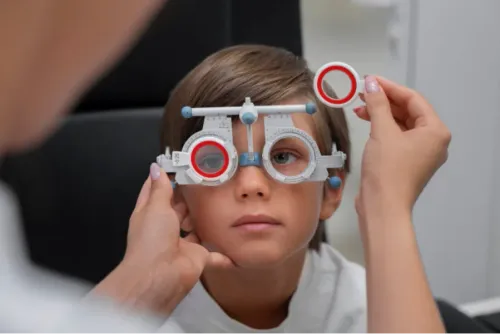
The examination therefore needs to evaluate more than cosmetic alignment. Visual acuity, spectacle power, eye movements, ocular health, and binocular function may all be relevant.
Does Every Squint Require Surgery?
No.
Management depends on the type and cause of the deviation.
Some children may have strabismus associated with refractive error and may benefit from appropriate spectacle correction. Others may require amblyopia treatment, observation, prisms in selected situations, or surgery depending on clinical findings.
The treatment plan should follow a proper diagnosis.
Adult-Onset Strabismus Is Different
A new eye deviation in an adult can cause double vision because the mature visual system may not suppress the second image in the same way a young child's brain can.
Potential causes vary and can include problems involving eye muscles, nerves, previous eye surgery, trauma, thyroid-related eye disease, or neurological conditions.
New-onset double vision or sudden eye misalignment deserves medical assessment.
What Happens During Evaluation?
The ophthalmologist may examine:
- Visual acuity in each eye
- Spectacle prescription
- Eye alignment at different distances
- Eye movements
- Binocular vision
- Anterior eye structures
- Retina or optic nerve where indicated
The pattern of the deviation can provide clues about the underlying mechanism.
What Should You Ask Before Treatment?
Patients or parents can ask what type of strabismus is present, whether spectacle correction is required, whether amblyopia exists, what treatment options are appropriate, and what outcome is expected.
If surgery is discussed, it is useful to understand its objective. Depending on the individual case, treatment goals can involve improving alignment, binocular function where possible, symptoms such as double vision, or a combination of factors.
When Should Assessment Be Prioritised?
A persistent eye turn in a child should not be ignored simply because the child does not complain.
In adults, sudden double vision, new eye misalignment, drooping eyelid, severe headache, weakness, numbness, speech difficulty, or other neurological symptoms may require urgent medical evaluation.
Strabismus is not a single uniform condition. Identifying its type, cause, and effect on vision is the foundation for deciding what treatment, if any, is appropriate.
Keywords